
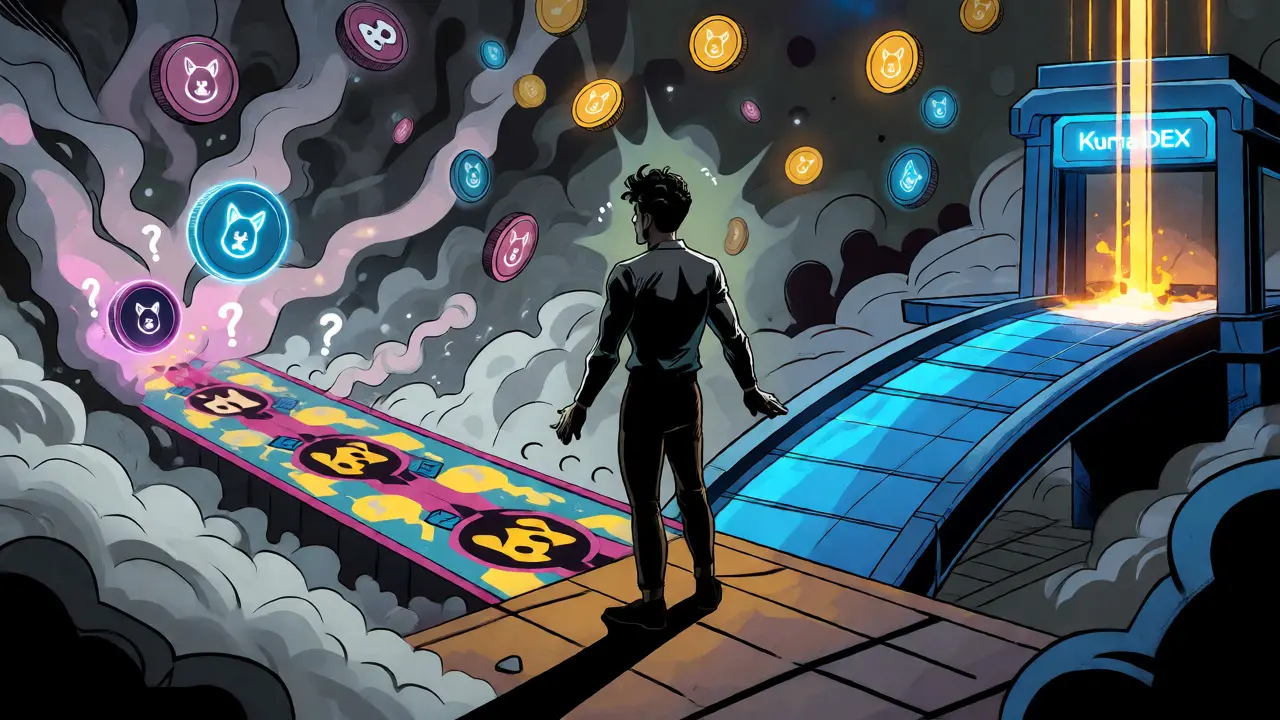
Did you just see a flashy tweet claiming the Kuma Inu is dropping free tokens for everyone? You’re not alone. The crypto space is flooded with announcements, and distinguishing between a legitimate opportunity and a hype-driven mirage can feel like finding a needle in a haystack of memes. Here’s the cold hard truth right off the bat: as of September 2026, there is no officially confirmed, active "Event Airdrop" specifically for the Kuma Inu (KUMA) meme token project that has been verified by major tracking platforms or the core team through official channels.
This confusion isn't accidental; it’s structural. Two completely different projects are sharing similar names, creating a perfect storm for misinformation. On one side, you have Kuma Inu, a community-driven meme token focused on yield farming via its Kuma Breeder protocol. On the other, you have Kuma (formerly IDEX), a serious decentralized exchange platform that rebranded in March 2025 to integrate with the Berachain ecosystem. If you’re hunting for an airdrop, you need to know exactly which "Kuma" you’re talking about, because mixing them up could cost you time, gas fees, or worse-your private keys.
The Identity Crisis: Kuma Inu vs. Kuma DEX
Before you connect your wallet to any site promising free KUMA tokens, let’s clear up the identity crisis. This is the single most important step in your due diligence process.
Kuma Inu is what most retail investors think of when they hear "Kuma." It’s a meme coin with DeFi aspirations. Its native token trades under the ticker KUMA. The project markets itself on community governance and a yield farming system called Kuma Breeder. However, recent data shows extremely low trading volume, often hovering near zero USD in 24-hour periods. For an airdrop to make sense, there needs to be an active economy to receive the tokens. Currently, that engine is idling.
In contrast, Kuma (the DEX) is a hybrid decentralized exchange founded back in 2017. It rebranded from IDEX to align with Berachain, a blockchain known for its Proof of Liquidity consensus mechanism. This platform launched a reward program in April 2025 where users earn BGT (Berachain Gas Token) by trading perpetual futures. This is a real, active incentive program. But here’s the kicker: these rewards are primarily in BGT or points leading to potential future distributions, not necessarily immediate free KUMA Inu tokens.
| Feature | Kuma Inu (Meme Token) | Kuma (DEX/Berachain) |
|---|---|---|
| Primary Focus | Meme culture, Yield Farming (Kuma Breeder) | Decentralized Trading, Perpetual Futures |
| Token Ticker | KUMA | Varies (Rewards in BGT/Points) |
| Airdrop Status | Unconfirmed / No Active Event | Active Reward Program (BGT Rewards) |
| Ecosystem | Standalone Meme/DeFi Hybrid | Berachain Ecosystem Integration |
| Trading Volume | Negligible / Near Zero | High / Active Institutional Interest |
Is There Actually a Kuma Inu Airdrop?
Let’s look at the evidence. Major airdrop aggregators like Airdrops.io list the status for Kuma-related distributions as "unconfirmed." This label is crucial. In the crypto world, "unconfirmed" usually means one of three things: the rumor mill is spinning but nothing is signed in stone, the project is testing community interest, or-and this is common-it’s a mix-up with another project.
For Kuma Inu specifically, there are no published smart contract addresses for a new airdrop distribution, no snapshot dates announced, and no eligibility criteria released. Compare this to legitimate projects like Yei Finance, which recently ran a structured CLO token airdrop with clear phases: registration deadlines, allocation confirmations, and claim windows. Kuma Inu lacks this infrastructure. Without a transparent roadmap detailing how the airdrop will work, who qualifies, and when claims open, any website asking you to "claim now" is likely operating on speculation or, more dangerously, phishing tactics.
Why does this matter? Because in 2026, regulatory scrutiny on crypto airdrops is tighter than ever. Projects that distribute tokens without clear utility or legal compliance face headwinds. Kuma Inu’s current lack of active development updates suggests that if an airdrop happens, it might be delayed indefinitely or canceled entirely.

The Berachain Connection: Where the Real Rewards Are
If you are seeing buzz about "Kuma rewards," it is almost certainly referring to the Kuma DEX on Berachain. This is where the actual activity is happening. Since its rebranding in early 2025, Kuma DEX has incentivized traders to move their liquidity away from centralized exchanges. They do this by offering BGT rewards for trading perpetual futures.
This isn’t a traditional "free money" airdrop where you hold a bag and wait. It’s a merit-based system. You trade, you provide liquidity, you get rewarded. This distinction is vital for your strategy. If you’re holding Kuma Inu tokens hoping for a passive windfall, you might be waiting forever. If you’re willing to actively trade on the Kuma DEX platform, you might actually earn something valuable.
The Proof of Liquidity model used by Berachain changes the game. Unlike traditional proof-of-stake chains where staking locks up capital, PoL encourages circulating liquidity. Kuma DEX leverages this by rewarding users who keep assets moving. So, while Kuma Inu holders sit idle, Kuma DEX users are accumulating BGT. Is BGT worth more than speculative KUMA Inu? Given the current market data showing near-zero volume for KUMA Inu, the answer leans heavily toward yes.
Red Flags: How to Spot a Fake Kuma Airdrop
Because the name is ambiguous, scammers love to exploit it. If you encounter a "Kuma Inu Airdrop" promotion, check for these red flags before connecting your wallet:
- No Official Announcement: Did the post come from the verified Twitter/X account of Kuma Inu? Or is it a random influencer or bot account? Scammers often use generic graphics with the word "AIRDROP" in big letters.
- Wallet Connect Prompts: Legitimate airdrops rarely require you to connect your main hot wallet to a third-party site immediately. Often, they ask you to sign a message or send a small amount of ETH/SOL to verify ownership. If a site asks you to approve unlimited spending rights to your USDT or ETH, walk away.
- Gas Fee Demands: Be wary of sites asking you to pay a large upfront fee to "unlock" your airdrop. While some real airdrops have claim fees, they are usually minimal network costs, not arbitrary project fees.
- Phishing Domains: Check the URL. Is it kumainu.com or kuma-inu-airdrop-claim.xyz? Typosquatting is rampant. Always navigate to the official site manually rather than clicking links in social media posts.
What Should You Do With Your Kuma Inu Holdings?
If you already hold Kuma Inu tokens, don’t panic. The absence of an immediate airdrop doesn’t mean the project is dead, but it does mean the momentum has stalled. Here is a practical approach:
- Monitor Governance Proposals: Kuma Inu touts a decentralized autonomous organization (DAO). Keep an eye on their Discord or Telegram for proposals regarding marketing budgets or partnership announcements. An airdrop is often a tool for marketing. If they aren’t spending on marketing, they probably aren’t planning a mass distribution.
- Diversify into Active Ecosystems: Consider reallocating a portion of your portfolio to ecosystems with proven reward mechanisms, like Berachain or Arbitrum, where incentives are clearer and more frequent.
- Set Alerts: Use tools like CoinGecko or DexScreener to set price alerts. If KUMA sees a sudden spike in volume, investigate why. It could signal news of a partnership or a revived development effort.
The Future Outlook for Kuma Tokens
Predicting the price of micro-cap meme coins is notoriously difficult. Analysts have projected various scenarios for Kuma Inu, ranging from modest gains to stagnation. Some models suggest a potential rise to $0.00000001094 by late 2025, but given we are now in September 2026, those predictions have largely failed to materialize, highlighting the volatility and unpredictability of this asset class.
The broader context matters too. The meme coin sector is consolidating. Investors are becoming smarter, favoring tokens with strong communities and tangible utility over pure hype. Kuma Inu needs to demonstrate either strong community retention or a unique feature set to survive the next cycle. An airdrop could serve as a catalyst for this, but only if executed with transparency and backed by genuine user engagement.
For now, treat any "Kuma Inu Airdrop" rumor with healthy skepticism. Verify the source, understand the difference between the meme token and the DEX, and never rush into a transaction based on FOMO (Fear Of Missing Out).
Is there a confirmed Kuma Inu airdrop in 2026?
No, there is currently no officially confirmed active airdrop event specifically for the Kuma Inu (KUMA) meme token. Most reports refer to unverified rumors or confuse it with the Kuma DEX reward program on Berachain.
What is the difference between Kuma Inu and Kuma DEX?
Kuma Inu is a meme token focused on yield farming and community governance. Kuma DEX (formerly IDEX) is a decentralized exchange platform integrated with the Berachain ecosystem, offering trading rewards in BGT.
How can I earn rewards from Kuma DEX?
You can earn BGT (Berachain Gas Token) rewards by trading perpetual futures and providing liquidity on the Kuma DEX platform. This is an active participation model, not a passive holding reward.
Should I sell my Kuma Inu tokens if there is no airdrop?
It depends on your risk tolerance. Kuma Inu currently has very low trading volume. If you believe in the long-term community vision, you may hold. If you prefer active yield opportunities, consider diversifying into ecosystems with clearer reward structures.
Are Kuma Inu airdrop scams common?
Yes, due to the name similarity with the popular Kuma DEX, scammers frequently launch fake airdrop campaigns. Always verify announcements through official social media channels and avoid connecting wallets to unknown websites.
 Cryptocurrency Guides