
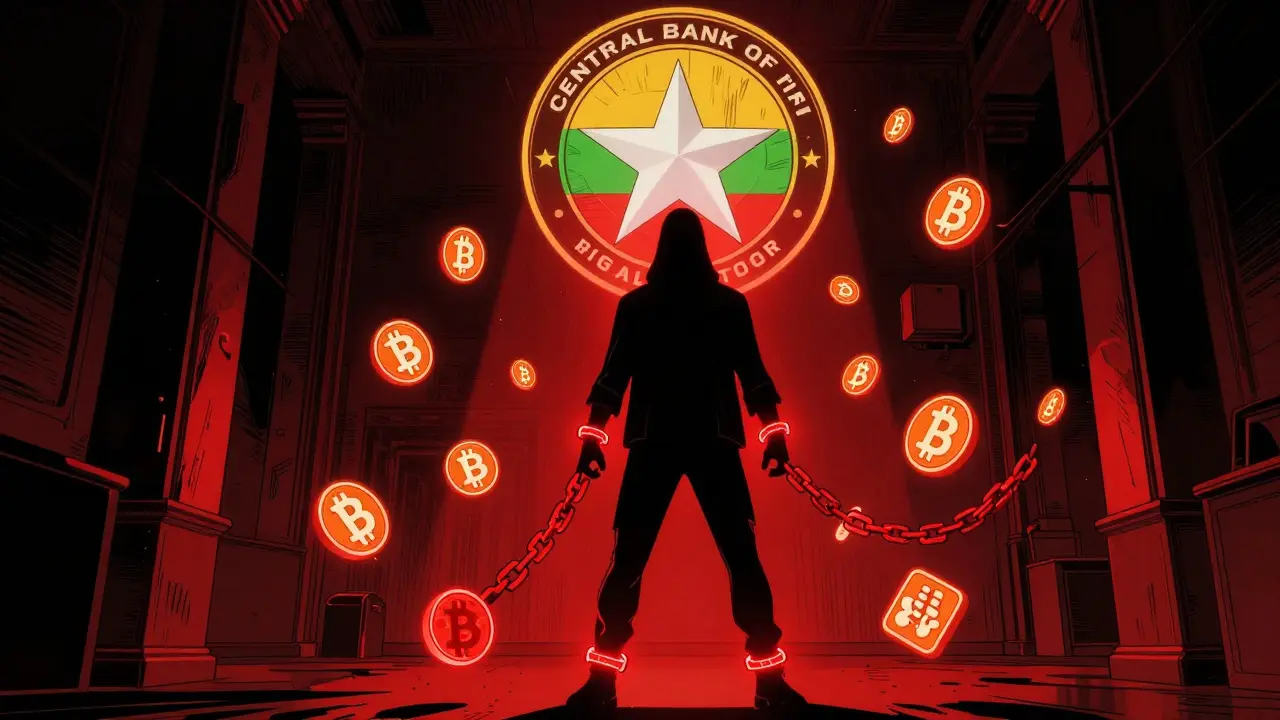
If you're thinking about buying Bitcoin, selling Ethereum, or using USDT to send money out of Myanmar, you need to understand one thing: your bank account can vanish overnight. And it’s not just about losing access to your money - you could end up in jail.
Myanmar doesn’t just discourage cryptocurrency use. It actively hunts people who use it. Since May 2024, the Central Bank of Myanmar (CBM) has been closing bank accounts, filing criminal charges, and even pressing for prison time against anyone caught trading, mining, or transferring digital currencies. This isn’t a warning anymore - it’s a crackdown.
How the CBM Enforces the Crypto Ban
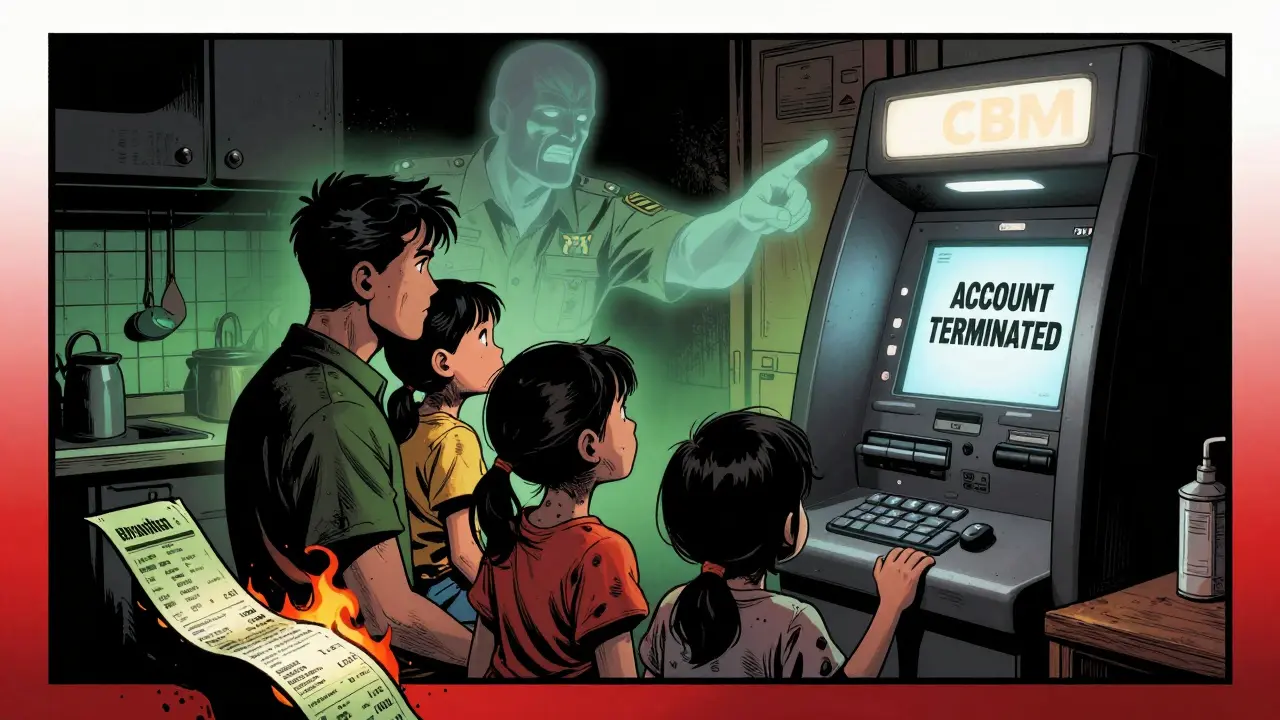
The CBM doesn’t need a court order to shut down your account. They just call your bank. One day, your savings, your business payments, your salary deposits - all gone. No notice. No appeal. Just silence.
This power comes from three laws: the Central Bank of Myanmar Law, the Financial Institutions Law, and the Anti-Money Laundering Law. Together, they give the CBM full control over every financial transaction in the country. Any digital currency - Bitcoin, Ethereum, Litecoin, Perfect Money, or USDT - is treated as illegal foreign currency. And under Myanmar’s rules, dealing in foreign currency without permission is a criminal offense.
The CBM’s public notice in May 2024 was clear: “Anyone involved in the sale, purchase, exchange, or transfer of unregulated digital currencies will have their accounts closed and face legal action.” They didn’t say “may.” They said “will.” And they’ve followed through.
What Gets You Targeted
You don’t need to be a miner or a trader to get caught. Just using crypto in any way can trigger action:
- Buying USDT on a peer-to-peer platform like LocalBitcoins or Paxful
- Sending Tether via Telegram to pay for goods or services
- Receiving crypto as payment for freelance work
- Using Facebook or Instagram to advertise crypto trading services
- Even helping someone else buy crypto - you can be charged as an accomplice
The CBM monitors bank transfers linked to known crypto-related addresses. If your account sends money to a wallet flagged in their system - even once - they freeze everything. They’ve also started tracking online activity. People who post about crypto on Facebook or run crypto-related pages have been raided, interrogated, and arrested.
The Real Cost: More Than Just a Closed Account
Account closure is just the beginning. The real punishment is far worse.
Under Myanmar’s Anti-Money Laundering Law, anyone convicted of cryptocurrency transactions can face:
- Up to 10 years in prison
- Fines of up to 100 million kyat (roughly $4,000 USD, but worth far less due to inflation)
- Confiscation of all assets tied to the transaction
In 2024, at least three people were sentenced to prison terms after being caught using USDT to send money abroad. One man tried to pay his sister’s medical bills using crypto because the kyat had lost 60% of its value. He was arrested at home, his phone and laptop seized, and his bank accounts frozen. He spent eight months in detention before being released without charge - but his business never recovered.
There’s no public record of how many accounts have been closed. But insiders say hundreds, possibly over a thousand, since May 2024. Banks have been ordered to report any suspicious activity - and crypto-related transfers are now automatically flagged.
Why the CBM Is So Harsh
Myanmar’s military government fears two things: losing control of money, and losing power.
After the 2021 coup, the kyat collapsed. Inflation hit 50% in some areas. People stopped trusting the government’s currency. That’s when crypto became popular - not because it was cool, but because it was the only way to protect savings or send money out of the country.
The CBM saw this as a threat. If people can bypass the kyat, they can bypass the state. If they can send money overseas without going through official channels, they can fund opposition groups. That’s why the CBM didn’t just ban crypto - they turned it into a national security issue.
They’ve also been watching what’s happening in neighboring countries. Thailand and Laos are becoming crypto hubs. Miners from Myanmar have moved their rigs there. The CBM doesn’t want that to happen inside its borders.
What About the National Unity Government (NUG)?
Here’s the twist: while the military government bans crypto, the opposition National Unity Government (NUG) declared USDT legal tender in December 2021 in areas it controls.
That means if you’re in a region run by the NUG - like parts of Karen State or Kachin State - using USDT might be safe. But if you cross into a junta-controlled area, even briefly, your phone could be scanned, your bank account checked, and your history traced.
There’s no legal protection for this. You can’t claim “I’m with the NUG” to avoid punishment. The CBM doesn’t recognize them. And if you’re caught with crypto in a junta-run city, you’re treated as a criminal - no exceptions.

How People Are Still Using Crypto (And Why It’s Dangerous)
Despite the risks, crypto use hasn’t disappeared. It’s gone underground.
Telegram groups are now the main way people trade USDT. Wallets are shared through encrypted chats. Payments are made via QR codes scanned in public markets. Some even use mining rigs hidden in basements or rural homes, powered by stolen electricity.
But here’s the problem: these systems are not secure. Informants are everywhere. Someone you trust might report you. A friend might get arrested and give your name under pressure. A transaction you made months ago might suddenly get flagged.
There’s no anonymity that can protect you from the CBM’s reach. They don’t need to crack your wallet. They just need to see where your bank account sent money - and then they have you.
The Digital Kyat Is Coming - And It’s Not a Solution
In June 2025, the CBM created the Central Committee for the Issuance of Central Bank Digital Currency. Their goal? Launch a government-controlled digital kyat.
This isn’t about innovation. It’s about control. The digital kyat will track every transaction. No privacy. No anonymity. No way to move money outside the system.
It’s the opposite of Bitcoin. Where crypto lets you escape state control, the digital kyat will lock you into it.
For now, the digital kyat is still in testing. But once it rolls out, using any other digital currency - even USDT - will be even riskier. The CBM will have a full digital trail of every citizen’s spending. Crypto users will be easy to spot.
What You Should Do If You’re in Myanmar
If you’re living in Myanmar and have crypto:
- Don’t transfer it. Don’t sell it. Don’t even talk about it.
- Close any crypto-related social media pages.
- Stop using Telegram or Facebook for crypto payments.
- Do not use your bank account to buy or send crypto - even once.
If you’re thinking of starting:
- Don’t. The risk isn’t worth it.
- There are no safe exchanges, no legal loopholes, no protection.
- Even if you think you’re careful - you’re not.
The CBM has made it clear: crypto is not a tool. It’s a crime. And they’re not bluffing.
Can I still use crypto in Myanmar if I don’t use my bank account?
No. The CBM doesn’t just monitor bank accounts. They track phone numbers, IP addresses, and online activity. If you use crypto through Telegram, Facebook, or peer-to-peer apps, your device can be traced. Even cash-based trades can be linked to you if you’ve ever used a bank account in the past. There is no safe way to use crypto in Myanmar under current laws.
What happens if I’ve already used crypto in Myanmar? Can I avoid punishment?
If you’ve used crypto before May 2024, you may have escaped notice - but that doesn’t mean you’re safe. The CBM can still access transaction records from banks and exchanges. If you’re flagged later - say, by a friend getting arrested - your past activity can be used against you. There’s no statute of limitations. The risk never goes away.
Is mining crypto illegal in Myanmar?
Yes. Mining is treated the same as trading. The CBM considers it illegal currency conversion and unauthorized financial activity. Mining rigs have been seized during raids. People caught mining have been arrested and charged under the Financial Institutions Law. Even running a small rig in your home is enough to trigger an investigation.
Can I open a new bank account after mine was closed for crypto use?
Highly unlikely. Banks in Myanmar share customer data with the CBM. If your name is flagged for crypto activity, no bank will open an account for you. Even applying for a new account can trigger a review. Many people who lost accounts have been permanently locked out of the formal banking system.
Why does Myanmar care so much about crypto when other countries don’t?
Myanmar’s military government controls every part of the economy. Crypto threatens that control by letting people move money outside the system. After the kyat collapsed and inflation soared, crypto became a lifeline for many - but also a threat to the regime’s power. They banned it not because it’s dangerous, but because it’s free. And freedom is the one thing they can’t tolerate.
 Cryptocurrency Guides
Gaurav Mathur
February 13, 2026 AT 16:56Keturah Hudson
February 14, 2026 AT 06:55Andrea Atzori
February 14, 2026 AT 22:39Joe Osowski
February 15, 2026 AT 19:23John Doyle
February 16, 2026 AT 22:32Elizabeth Choe
February 18, 2026 AT 07:37Grace Mugambi
February 18, 2026 AT 11:20Crystal McCoun
February 20, 2026 AT 01:18Beth Trittschuh
February 20, 2026 AT 20:46Benjamin Andrew
February 20, 2026 AT 20:50Donna Patters
February 22, 2026 AT 07:26Holly Perkins
February 22, 2026 AT 12:04Will Lum
February 22, 2026 AT 15:32Ben Pintilie
February 23, 2026 AT 19:22Sakshi Arora
February 25, 2026 AT 00:03Ekaterina Sergeevna
February 25, 2026 AT 04:08Brittany Meadows
February 25, 2026 AT 13:28SAKTHIVEL A
February 25, 2026 AT 13:52